This article contains affiliate links. If you purchase through these links, we may earn a commission at no extra cost to you.
If peptides had their breakthrough moment and retinol is now a household word, growth factors are the ingredient earning the most serious attention from dermatologists right now — and for mature skin over 40, the reasons are deeply clinical. Unlike trends that surface for a season and disappear, this is a category backed by decades of published research and a mechanism of action rooted in how skin actually repairs and renews itself. Cellular signals slow with age. Collagen production declines. Repair processes that once happened automatically begin to need support. Understanding this ingredient category is, at its core, understanding how aging skin can be taught to speak its own language again. This guide covers the science, the sourcing, and everything you need to know before you invest.
Table of Contents
What Are Growth Factors?
Growth factors are naturally occurring proteins found throughout the body that function as cellular messengers. According to Dr. Connie Yang, board-certified dermatologist and member of Explore’s Medical Advisory Board, they are proteins or peptides that help “repair damage, stimulate cell growth, and promote production of various components of the skin like collagen and elastin.” They work by binding to receptors on the surface of skin cells and triggering a cascade of signals that instruct those cells to heal, regenerate, and replicate.
Board-certified dermatologist Dr. Hadley King of Weill Medical College of Cornell University describes the mechanism directly: “When [growth factors] bind to receptors on cell surfaces, they can send commands to repair, rejuvenate and replicate. They are used for anti-aging because they can increase collagen and elastin, thicken skin and improve tone and texture.”
In younger skin, these proteins operate continuously and abundantly. The body produces them in response to stress, injury, and the constant demands of cellular renewal. The problem — and this is the heart of why this ingredient category matters so profoundly for women over 40 — is that production declines with age. Slower signaling means slower repair, reduced collagen synthesis, thinner skin, and a diminished ability to recover from UV damage, inflammation, and daily environmental stress.
Why Growth Factors Matter After 40
The relationship between declining cellular signaling proteins and visible skin aging is not theoretical — it is observable in the skin itself. The loss of firmness, the deepening of lines, the increased fragility that often accompanies menopause: these are in part the downstream effects of a communication system that has become less efficient over time.
Dr. Fricke of Alamo Heights Dermatology explains the scope of their role: “In the skin, [growth factors] signal cells — such as fibroblasts and keratinocytes — to repair damage, produce collagen and elastin, and regenerate healthy tissue — especially as these signals decline with age.”
Fibroblasts — the cells responsible for producing collagen and elastin — are dependent on this type of protein signaling. When signaling is strong, fibroblasts remain active and productive. As it declines, the structural scaffolding of mature skin begins to visibly deteriorate. Restoring that signal, even partially, is the clinical premise behind topical application — and it is one with meaningful published evidence behind it.
The Different Types Used in Skincare
Not all formulas in this category are the same. Understanding the distinctions helps separate clinically substantive products from those using the terminology without the science to support it.
Epidermal Growth Factor (EGF) is among the most studied. It signals keratinocytes — the primary cells of the outer skin layer — to divide and renew, accelerating surface repair and supporting barrier integrity. Particularly relevant for mature skin managing UV damage, surface pigmentation, and barrier compromise.
Fibroblast Growth Factor (FGF) targets fibroblasts directly, stimulating collagen and elastin production. For women over 40 dealing with visible loss of firmness and skin density, FGF-driven formulas address structural decline at its source.
Multi-protein complexes combine several signaling proteins — including cytokines and interleukins — in ratios that more closely replicate the signaling environment of healthy young skin. These are considered the most comprehensive approach in the clinical skincare category because they address multiple pathways simultaneously rather than targeting a single protein type.
Plant-derived and synthetic alternatives mimic the signaling function of human proteins without animal or human sourcing. Appropriate for those who prefer vegan formulas, though research on their potency relative to human-derived counterparts continues to develop.
Where Growth Factors Come From
The origins of these actives in skincare is a topic dermatologists are asked about consistently — and worth addressing directly. Growth factors in topical skincare do not involve the use of actual human fluids or tissues. They are derived from proteins produced by cells cultured under highly controlled laboratory conditions, then stabilized and concentrated into skincare formulas.
The main sourcing approaches are human cell-conditioned media, recombinant bioengineered proteins designed to precisely replicate specific human signals, and plant-derived signaling peptides. Dr. Fricke notes that “medical-grade growth factor products are typically more concentrated, better stabilized, and supported by clinical research” — a meaningful distinction when choosing where to invest for mature skin with advanced aging concerns.
What the Science Says
Clinical evidence has accumulated significantly over the past two decades. Dr. Ronald Sulewski of Nebraska Medicine states it plainly: “Growth factors stimulate collagen with external application.” Studies consistently demonstrate improvement in fine line appearance, skin texture, firmness, and overall tone with regular topical use. Results in most clinical contexts appear within four to eight weeks, with full benefit developing over twelve weeks of consistent use — and continuing to improve beyond that window.
The caveat worth understanding: potency varies substantially with concentration, delivery system, formulation stability, and the specific proteins included. Dr. Garshick, cited in Refinery29’s 2025 skincare outlook, describes these proteins as “types of proteins which increase skin hydration and stimulate skin cell generation — also notable in boosting and supporting collagen production.” The ingredient category is well validated; the execution varies considerably between products.
Growth Factors vs. Peptides: Understanding the Difference
This is one of the most common points of confusion in the anti-aging skincare category — and it matters for making intelligent purchasing decisions.
Peptides are short amino acid chains that signal collagen and elastin production by mimicking fragments of structural proteins. They communicate with skin cells via a different and generally less direct pathway than these signaling proteins. Both are cellular signaling approaches; the proteins in this category operate at a broader and more complex level, instructing cells across multiple repair and renewal pathways simultaneously.
Think of peptides as a focused message to a specific team. Growth factors are a full operational signal to an entire system. For women over 40 building an anti-aging routine, peptides are an excellent and accessible starting point — see our peptides for skin firming guide for the full breakdown. Clinical-grade formulas from brands with published research represent the more advanced tier of cellular signaling skincare — with the science and pricing that reflects that distinction.
How to Layer Into a Mature Skincare Routine
Growth factors are well tolerated and compatible with most mature skincare routines, including those incorporating retinol and Vitamin C. Apply to clean skin before moisturizer for maximum contact with skin cells before occlusion.
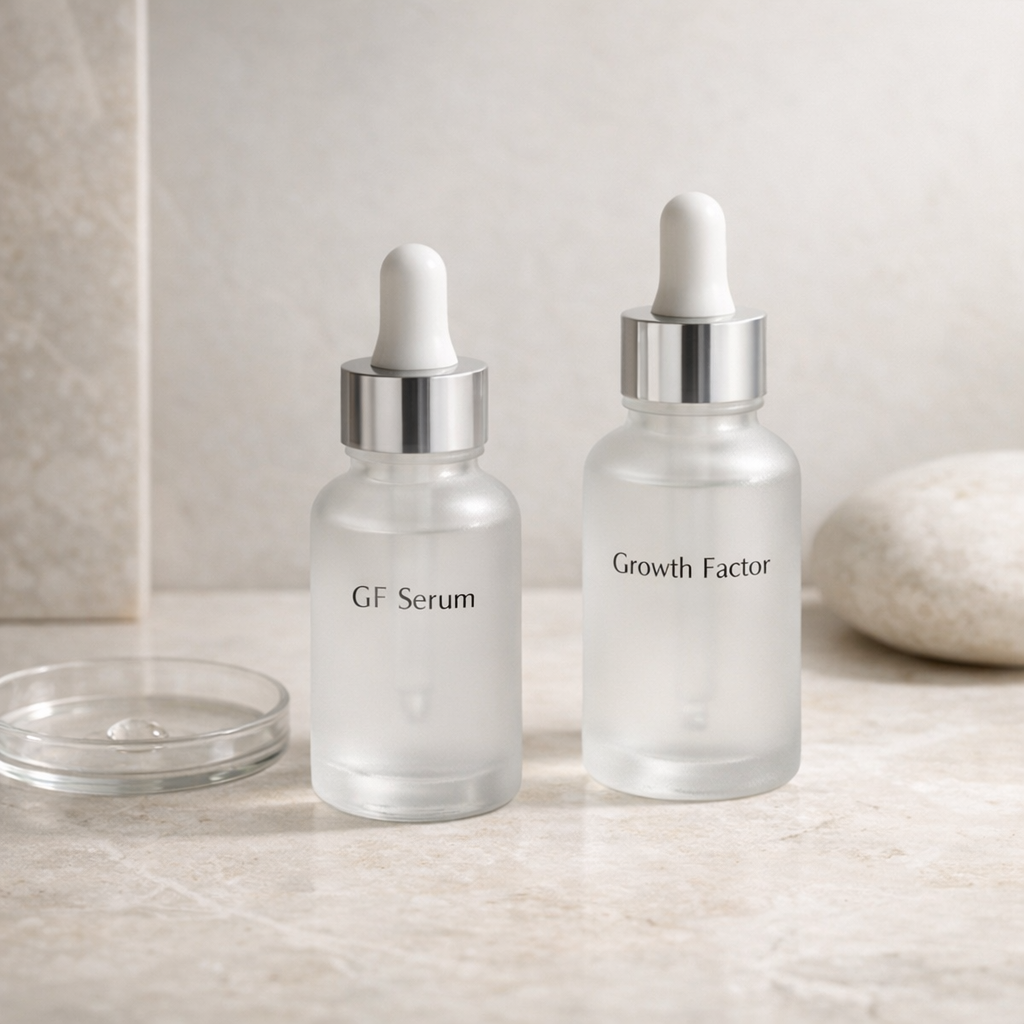
Morning: Cleanser → Growth Factor Serum → Moisturizer → SPF
Evening: Cleanser → Growth Factor Serum → Retinol (applied after serum absorbs) → Moisturizer
These proteins and retinol are not competing — they are complementary. Retinol accelerates cell turnover; this ingredient signals the repair and renewal that makes that turnover productive. For women over 40, the combination addresses skin aging more comprehensively than either alone. For the full routine framework, see our complete anti-aging skincare routine for women 40+.
Who Should Consider Adding Them
According to Dr. Yang, this ingredient class is well tolerated by most skin types but “especially beneficial for those with mature, damaged, or post-treatment skin due to their inherent rejuvenating, healing, and restorative properties.” They are also appropriate for women beginning to address preventative aging — not solely reactive treatment.
Practically speaking, the Vault’s guidance for women over 40 is this: if you have your cleansing, SPF, and a retinol or Vitamin C already established, you have the foundation to add this category meaningfully. If you are still building those basics, start there. Growth factors reward a routine that is already functioning — they elevate and accelerate what is already working. For a full picture of where they fit in a layered approach, see our best retinol serums for mature skin, best Vitamin C serums for mature skin, and best serums for mature skin guides.
What to Look For in a Formula
Not all products that list these proteins in their ingredients are equal. When evaluating a formula, the Vault looks for four things.
Clinical validation. The brand should be able to point to published studies or consumer trials with specific, measurable results — not vague claims of “renewal” or “rejuvenation.” Look for published percentages, trial duration, and participant counts.
Concentration and stability. These are biologically active proteins. They degrade when exposed to light, heat, and air. Proper packaging — airless pumps, opaque containers — is not cosmetic detail. It is a signal that the formula has been engineered to keep its actives viable through the full use of the product.
Delivery system. An active protein sitting on the surface of skin without a delivery mechanism to support penetration will not produce clinical results. The most effective formulas pair these proteins with peptides, amino acids, or proprietary delivery systems that support bioavailability.
Sourcing transparency. Reputable brands are specific about their sourcing — whether human cell-conditioned media, recombinant bioengineered proteins, or plant-derived alternatives. Vague labeling on a product claiming to contain these actives is a flag worth noting.
❓ Frequently Asked Questions
What are growth factors and how do they work in skincare? Naturally occurring proteins that act as cellular messengers — signaling skin cells to repair damage, produce collagen and elastin, and regenerate healthy tissue. Applied topically, they help restore the signaling efficiency that naturally declines as skin ages past 40.
Are they safe for all mature skin types? Yes. They are well tolerated by most skin types and particularly beneficial for mature, damaged, or post-procedure skin. Most clinical-grade formulas are fragrance-free and non-comedogenic, making them appropriate even for sensitive mature skin.
How long does it take to see results? Visible improvement in texture and tone typically appears within four to eight weeks. Deeper results — firmness, fine line reduction, density improvement — develop over twelve weeks of consistent use, with continued improvement beyond that initial window.
Can I use them alongside retinol? Yes — the combination is highly effective for mature skin. Apply the serum first and allow it to absorb, then follow with retinol. Both drive renewal; they work via different pathways and complement each other rather than competing.
What is the difference between growth factors and peptides? Growth factors are signaling proteins that instruct cells across multiple repair and renewal pathways simultaneously. Peptides are shorter amino acid chains that signal collagen production via a more targeted, less comprehensive mechanism. Peptides are an excellent entry point; clinical-grade formulas with published human-derived protein complexes represent the more advanced tier.
Are human-derived sources ethical? Yes. These proteins in skincare are derived from cells cultured under controlled laboratory conditions — not from actual human fluids or tissues. The process is bioengineered, clinically supervised, and subject to rigorous quality standards.
Is a medical-grade formula necessary to see results? Not necessarily — but concentration, stability, and delivery matter significantly. Medical-grade formulas are typically more concentrated and better stabilized than over-the-counter alternatives, and are more likely to deliver measurable results for mature skin with advanced aging concerns.
Do plant-derived alternatives work as well as human-derived versions? Plant-derived signaling alternatives can provide benefit, and are appropriate for those who prefer vegan formulas. The research on their potency relative to human-derived proteins is still developing. For women seeking the most clinically substantiated results, human cell-conditioned media and recombinant formulations currently have the stronger evidence base.
When in a routine should I apply these products? After cleansing and before moisturizer — both morning and evening. This allows maximum contact with skin cells before the moisturizer layer creates occlusion. See our complete anti-aging skincare routine for women 40+ for the full layering framework.
Who is this ingredient category best suited for? Women over 40 who have already established a foundational routine — cleanser, SPF, retinol or Vitamin C — and are ready to add a clinical-grade renewal step that addresses aging at the cellular level. Also appropriate for those beginning preventative aging work in their early 40s who want to maintain skin renewal capacity before more significant decline sets in.
📚 Continue Your Journey
← Previously in The Vault: Best Augustinus Bader Products for Mature Skin Over 40
Coming Next → The Vault puts the science into practice — a full product roundup of the best serums in this category for mature skin over 40, ranked and matched to every skin type and concern.
This article contains affiliate links. If you purchase through these links, we may earn a commission at no extra cost to you. The Vault curates on clinical evidence and editorial integrity — never on paid placement.
Comments are closed