This article contains affiliate links. If you purchase through these links, we may earn a commission at no extra cost to you.
Chemical exfoliation is one of the most consistently misunderstood steps in mature skincare — and one of the most transformative when done correctly. Unlike physical scrubs, which rely on manual friction, chemical exfoliation uses acids to dissolve the bonds that hold dead skin cells together, encouraging them to shed more efficiently and revealing the fresher, more radiant skin underneath. For women over 40, this process becomes increasingly important: as skin ages, its natural cell turnover rate slows significantly, which means dead cells accumulate on the surface longer, creating a dull, uneven texture that no moisturizer alone can address.
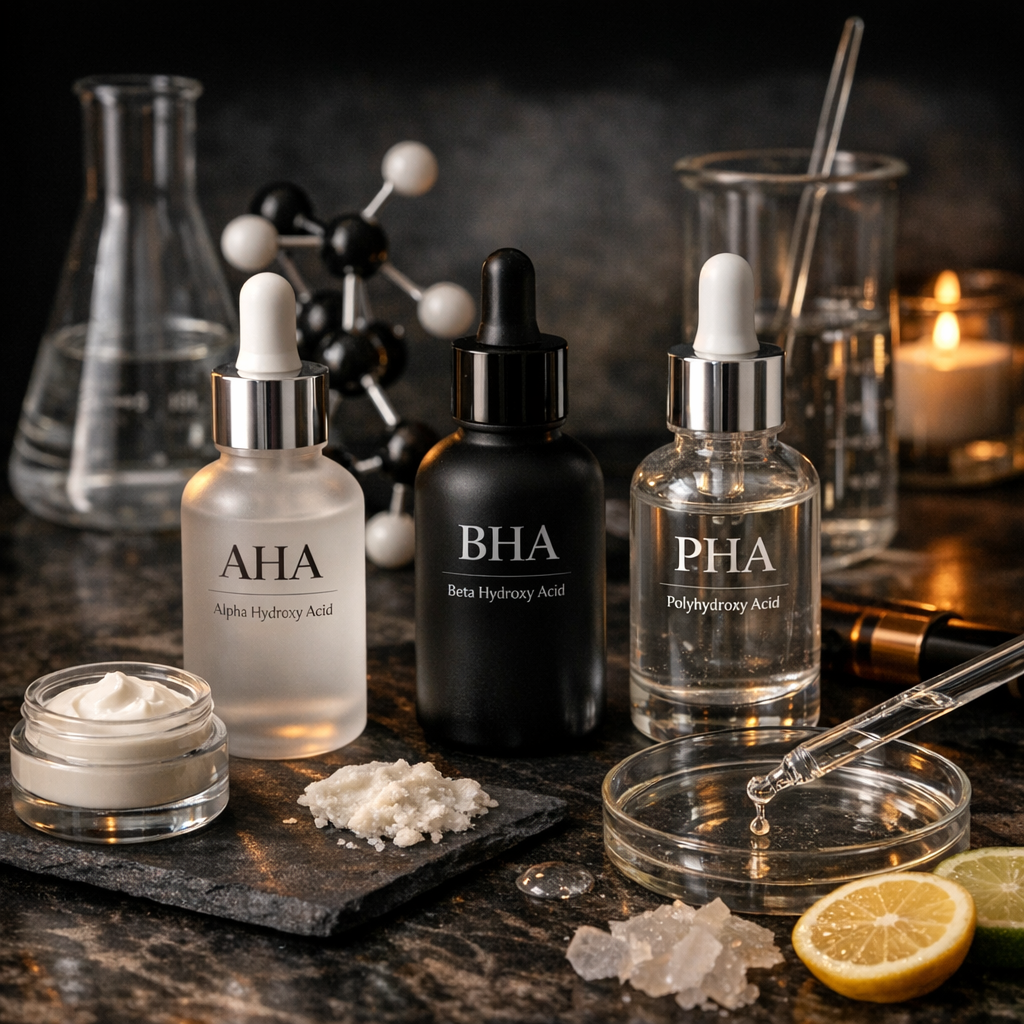
The three primary categories of chemical exfoliants — AHAs, BHAs, and PHAs — each work differently, target different skin concerns, and suit different skin types. Understanding the distinctions between them is the foundation of building an exfoliation routine that genuinely delivers results without compromising the skin’s barrier. This guide breaks down the science, the benefits, and the smart strategies for using each acid category at 40 and beyond.
Table of Contents
What Chemical Exfoliation Actually Does for Skin Over 40
To understand why chemical exfoliation matters so much after 40, it helps to understand what happens to cell turnover with age. In younger skin, the natural exfoliation cycle — the process by which skin cells form, migrate to the surface, and shed — takes approximately 28 days. By the mid-40s, that cycle can slow to 45 days or longer. The result is a buildup of dead, flattened cells on the skin’s surface that contributes to dullness, rough texture, uneven tone, and the appearance of deeper lines. Fine lines look more prominent when the skin’s surface is irregular; dark spots become more visible when dead cells accumulate around them; moisturizers and serums absorb less efficiently when there is a layer of cellular debris in the way.
Chemical exfoliants address this directly. By loosening the bonds between dead skin cells — a process called desquamation — they allow the skin to shed more efficiently and return closer to its younger, faster cell turnover rhythm. The downstream effects are significant: improved radiance, more even tone, better product absorption, and over time, an improvement in the appearance of fine lines and hyperpigmentation. When used consistently and correctly, chemical exfoliation is one of the highest-return investments in a mature skincare routine.
AHAs: Alpha Hydroxy Acids
What AHAs Are
Alpha hydroxy acids are water-soluble acids derived primarily from natural sources — fruit, milk, and sugar cane. They work on the skin’s surface, dissolving the bonds between dead cells in the outermost layer of skin (the stratum corneum) and encouraging them to shed. Because they are water-soluble, AHAs do not penetrate into the pore itself — their action is focused on the skin’s surface and the upper layers of the epidermis.
The most commonly used AHAs in skincare are:
- Glycolic acid — derived from sugar cane, the smallest molecular weight of the AHAs, penetrates most deeply and is typically the most potent. A strong choice for resilient skin with concerns about dullness, uneven tone, and fine lines.
- Lactic acid — derived from milk, larger molecular weight than glycolic, penetrates more gradually and with less potential for irritation. An excellent choice for sensitive and dry mature skin. Also has humectant properties, meaning it draws moisture into the skin as it exfoliates.
- Mandelic acid — derived from bitter almonds, the largest molecular weight of the commonly used AHAs, penetrates most slowly and gently. Well-suited to skin prone to hyperpigmentation and sensitivity, including post-menopausal skin with compromised barrier function.
- Tartaric acid and malic acid — less common as standalone actives but frequently used in combination formulas to support pH and enhance the performance of glycolic and lactic acids.
What AHAs Do for Mature Skin
For skin over 40, AHAs deliver several specific benefits that are particularly relevant to the concerns of this decade:
Surface renewal and radiance. By encouraging more efficient cell shedding, AHAs reveal the fresher, more reflective skin underneath — addressing the dullness that is one of the first visible signs of slowed cell turnover.
Hyperpigmentation and dark spots. AHAs help to disrupt the concentration of melanin in existing dark spots by removing the upper layers of pigmented cells more efficiently. Consistent use over several months produces a meaningful improvement in tone evenness. This works synergistically with brightening ingredients like vitamin C in the evening routine.
Collagen stimulation. At therapeutic concentrations, particularly glycolic acid at 8–15%, AHAs have been shown to stimulate collagen synthesis in the dermis. This is one of the mechanisms by which consistent chemical exfoliation contributes to the improved appearance of fine lines over time — not just through surface smoothing, but through deeper structural support.
Improved product absorption. Removing the layer of dead cells on the skin’s surface allows the actives in serums and treatments to penetrate more effectively, improving the overall return on the rest of the skincare routine.
AHA Concentrations and What They Mean
Understanding concentration is essential for using AHAs safely and effectively:
- Below 5%: Gentle introductory range. Suitable for very sensitive or reactive skin, or for daily use. Improves radiance and texture gradually with low risk of irritation.
- 5–10%: The effective therapeutic range for most skin types. Produces meaningful exfoliation, improvement in tone, and surface renewal with regular use. This is the sweet spot for most women over 40 beginning a chemical exfoliation routine.
- 10–20%: Clinical-strength range. Products at these concentrations require more careful use — typically 2–3 times per week maximum — and a well-established skin barrier. At this range, AHAs produce more pronounced results on texture and collagen remodeling.
- Above 20%: Professional peel territory. Not appropriate for home use without supervision.
pH also matters significantly: AHAs require a pH of approximately 3–4 to be bioavailable and effective. Formulas with higher pH values (closer to 5–6) may feel gentler but deliver minimal exfoliation benefit.
AHAs and Sun Sensitivity
AHAs increase photosensitivity — a well-established and important consideration for mature skin. Exfoliated skin is more vulnerable to UV damage, which means daily SPF is non-negotiable when AHAs are part of the routine. The Vault recommends applying AHAs in the evening only, and consistently wearing broad-spectrum SPF 30 or higher the following morning regardless of cloud cover or indoor plans. This is not optional — unprotected exfoliated skin exposed to UV accelerates photodamage, the opposite of the intended goal.
BHAs: Beta Hydroxy Acids
What BHAs Are
Beta hydroxy acids are oil-soluble acids — a critical distinction from AHAs. Because they are lipid-soluble, BHAs can penetrate through the sebum inside the pore itself, making them uniquely effective at clearing congestion and treating concerns that originate inside the follicle rather than on the skin’s surface.
The primary BHA used in skincare is salicylic acid, derived from willow bark. Salicylic acid has a long clinical history as both an exfoliant and an anti-inflammatory agent — the combination of these two properties makes it exceptionally versatile for skin that experiences both congestion and redness.
What BHAs Do for Mature Skin
BHAs are often associated primarily with acne-prone and oily younger skin — but they offer specific and meaningful benefits for mature skin over 40 as well:
Pore clarity and minimizing. As skin ages, pores can appear more prominent, particularly as collagen loss reduces the structural support around the follicle walls. BHAs penetrate into the pore lining and dissolve the oxidized sebum and cellular debris that cause pores to look enlarged. This does not change pore size structurally, but it significantly improves their appearance by keeping them clear.
Hormonal and menopausal breakouts. Many women over 40 experience a return of breakout activity related to hormonal fluctuation during perimenopause and menopause. BHAs are the most targeted chemical exfoliant for managing this concern without the drying harshness of benzoyl peroxide.
Redness and inflammation. Salicylic acid’s anti-inflammatory properties make it well-suited to skin experiencing the kind of low-grade diffuse redness that becomes more common in midlife. It calms the follicular environment while exfoliating, unlike AHAs which can temporarily increase flushing in reactive skin.
Surface exfoliation. While BHAs are best known for their pore-penetrating work, salicylic acid also exfoliates the skin’s surface, improving texture and radiance — though generally with a gentler surface effect than glycolic acid at equivalent concentrations.
BHA Concentrations
- 0.5–1%: Gentle introductory range. Suitable for sensitive skin or for those using BHA for the first time. Delivers mild pore-clarifying and surface exfoliation benefits.
- 2%: The benchmark therapeutic concentration for salicylic acid. At 2%, BHA delivers meaningful pore-clearing, exfoliation, and anti-inflammatory benefits. This is the concentration most commonly found in well-formulated over-the-counter BHA products and is appropriate for regular use on mature skin.
- Above 2%: Typically found in clinical or prescription preparations. Not standard for daily home use.
Like AHAs, BHAs require an acidic pH (approximately 3–4) to function as effective exfoliants. pH-neutral formulas labeled as containing salicylic acid deliver the anti-inflammatory benefit but minimal exfoliation effect.
PHAs: Polyhydroxy Acids
What PHAs Are
Polyhydroxy acids are the newest generation of chemical exfoliants and represent a meaningful evolution in the category — particularly relevant for mature skin. PHAs include gluconolactone, lactobionic acid, and galactose. They function similarly to AHAs in that they are water-soluble and work on the skin’s surface, but their molecular structure is significantly larger, which means they penetrate more slowly and less deeply.
This is not a weakness — it is precisely what makes PHAs the most suitable exfoliant category for the most sensitive, reactive, or compromised mature skin.
What PHAs Do for Mature Skin
Gentle, effective surface exfoliation. PHAs deliver the brightening, texture-smoothing, and tone-evening benefits of chemical exfoliation without the irritation potential of glycolic or salicylic acid. For skin that has historically been too sensitive to tolerate AHAs or BHAs, PHAs are often the entry point that finally makes chemical exfoliation accessible.
Humectant properties. PHAs — particularly lactobionic acid — are also humectants, meaning they draw moisture into the skin as they exfoliate. This dual action makes them uniquely compatible with dry and dehydrated mature skin, which benefits from exfoliation but cannot afford additional moisture loss in the process.
Antioxidant activity. PHAs have demonstrated antioxidant properties in research settings, providing a layer of environmental protection alongside the exfoliating function. This makes them particularly suitable for daytime use in lower-concentration formulas.
Barrier compatibility. Unlike glycolic acid, which can temporarily disrupt the skin’s barrier if overused, PHAs have been shown to support and strengthen the skin barrier over time. For women whose barrier has been compromised — by menopause, over-exfoliation, environmental exposure, or the use of retinoids — PHAs represent a way to exfoliate without further compromise.
Rosacea and reactive skin. PHAs are the most compatible chemical exfoliant for skin prone to redness, rosacea, or flushing. Their slow penetration rate and anti-inflammatory properties make them a rare instance of an exfoliant that reactive skin can genuinely tolerate.
PHAs and Retinol Compatibility
One of the most practical advantages of PHAs for the mature skin routine is their compatibility with retinol. Glycolic acid and retinol are frequently flagged as a sensitizing combination when used simultaneously. PHAs, by contrast, are generally tolerated alongside retinoid use — making them a strategic choice for women who are already committed to retinol as their primary anti-aging active and want to add exfoliation without compounding irritation risk.
Comparing the Three: A Strategic Summary
| Property | AHA | BHA | PHA |
|---|---|---|---|
| Solubility | Water-soluble | Oil-soluble | Water-soluble |
| Penetration depth | Surface to upper epidermis | Surface + inside pores | Surface only (large molecule) |
| Primary benefit | Radiance, tone, collagen | Pores, congestion, anti-inflammatory | Gentle exfoliation, barrier support |
| Best for | Dull, uneven, hyperpigmented skin | Congested, oily zones, hormonal breakouts | Sensitive, reactive, rosacea-prone |
| Sensitivity risk | Moderate (glycolic) to Low (mandelic) | Low to Moderate | Very low |
| Sun sensitivity | Yes — SPF essential | Mild increase | Minimal |
| Retinol compatibility | Use on alternating nights | Generally compatible | Most compatible |
| Daytime use | Not recommended | 0.5–1% acceptable | Yes, in lower concentrations |
How to Introduce Chemical Exfoliation Into a Mature Routine
The most common mistake with chemical exfoliation is doing too much too soon. Mature skin — particularly skin that is dry, barrier-compromised, or has not previously used acids — requires a gradual introduction to avoid the inflammation and sensitivity that undermine the long-term results.
Start with PHAs or lactic acid. For women new to chemical exfoliation, or those with sensitive or reactive skin, PHAs and lactic acid are the most forgiving starting points. Begin with use two evenings per week and allow four to six weeks for the skin to adapt before increasing frequency.
Introduce glycolic or salicylic acid slowly. Once the skin has adapted to gentler acids, glycolic and BHA can be introduced gradually — starting at lower concentrations (glycolic at 5–8%, salicylic at 0.5–1%) and building frequency over several weeks. Never introduce two new actives simultaneously.
Apply to dry skin. Chemical exfoliants are more potent on wet skin, where the pH of water reduces their effective acidity. Applying to fully dry skin (waiting five minutes after cleansing) reduces the risk of irritation and gives more predictable, controlled results.
Sequence correctly. Chemical exfoliants are applied after cleansing and before other serums and treatments. If using a vitamin C serum — which is also pH-dependent — apply the AHA first, wait five minutes, then layer vitamin C. If combining with niacinamide, niacinamide can follow without conflict.
Do not combine with retinol on the same night. For most skin types, using a chemical exfoliant and a retinoid on the same evening creates cumulative irritation that outweighs the benefit of either. Alternate evenings — exfoliant one night, retinol the next — is the standard Vault-recommended approach. PHAs are the exception and can often be used on the same evening as lower-strength retinol, but introduce this combination cautiously.
Always follow with SPF the next morning. As covered above, AHAs in particular increase photosensitivity significantly. The Vault considers daily broad-spectrum SPF non-negotiable for any woman using chemical exfoliation — even on cloudy days, even indoors near windows.
Exfoliation Frequency: Less Is More for Mature Skin
Over-exfoliation is one of the most common skincare mistakes for women over 40, and it is far more damaging than under-exfoliation. A compromised skin barrier — which over-exfoliation produces — presents as redness, stinging, increased sensitivity, breakouts, and paradoxically, more noticeable fine lines as the skin loses moisture rapidly. If the routine includes retinol, which itself provides exfoliation through cell turnover acceleration, the total exfoliation load should be considered collectively.
The Vault’s general guidelines by skin type:
- Normal to combination skin: AHA or BHA 3–4 times per week is typically well-tolerated once the skin has adapted.
- Dry or sensitive skin: PHAs or lactic acid 2–3 times per week, or a low-concentration AHA every other day.
- Skin using retinol regularly: Reduce exfoliant frequency to 1–2 times per week. The retinol is doing significant exfoliation work — additional acids should supplement, not stack.
- Reactive or rosacea-prone skin: PHAs 2–3 times per week, with professional guidance before introducing AHAs or BHAs.
Signs of over-exfoliation to watch for: persistent redness or stinging after application, skin that feels tight or “squeaky” rather than smooth after cleansing, increased sensitivity to other products, visible dryness or flaking that was not present before, and breakouts that appear after previously clear skin.
The Skin Barrier: The Non-Negotiable Foundation
No discussion of chemical exfoliation for mature skin is complete without addressing the skin barrier — the outermost protective layer that regulates moisture retention and shields the skin from environmental aggressors. After 40, barrier function naturally declines due to reduced ceramide production, hormonal shifts, and environmental cumulative exposure. Chemical exfoliation, used correctly, does not damage the barrier — but used incorrectly or excessively, it absolutely can.
The Vault’s recommendation: build a strong, well-hydrated barrier before adding chemical exfoliation. Ensure the routine includes ceramide-containing moisturizers, a hyaluronic acid serum for hydration, and a quality night cream to support overnight repair. A well-supported barrier tolerates exfoliation far more gracefully — and produces better results, because the underlying skin is healthier and more resilient.
Exfoliation and hydration are not competing priorities. They work most effectively in concert.
FAQ: Chemical Exfoliation for Mature Skin Over 40
1. Can I use AHAs and BHAs together? Yes — combining an AHA and a BHA in the same product or the same routine is a well-established approach. AHAs address the surface and tone while BHAs address the pore. Many well-formulated exfoliants include both. Start with a combined formula at moderate concentrations rather than layering two separate high-concentration acids.
2. Do I need to exfoliate if I use retinol? Retinol accelerates cell turnover and provides its own form of exfoliation — so women on a consistent retinol routine require less additional chemical exfoliation than those who are not. One to two evenings of AHA or PHA per week is typically sufficient alongside active retinol use. Avoid exfoliating on the same evening as retinol until the skin has fully adapted to both.
3. Can chemical exfoliation help with menopausal skin? Yes, meaningfully. Menopause accelerates the slowdown in cell turnover, reduces collagen synthesis, and often triggers the kind of dullness, uneven tone, and surface roughness that chemical exfoliation addresses directly. Lactic acid and PHAs are particularly well-matched to post-menopausal skin because their gentler penetration respects the reduced barrier resilience that often accompanies hormonal changes.
4. Is it safe to use chemical exfoliants every day? For most mature skin types, daily AHA or BHA use at high concentrations is not advisable. Daily use is possible with very low-concentration formulas (lactic acid below 5%, PHAs, salicylic acid at 0.5%) or toning formulas designed for daily application. Higher-strength acids require rest days to allow the barrier to recover.
5. Can I use a chemical exfoliant in the morning? PHAs and lower-concentration BHAs (0.5%) are generally appropriate for morning use, provided SPF is applied immediately after. AHAs are best reserved for evening use due to their more significant increase in photosensitivity. If using an AHA-containing toner or serum in the morning, broad-spectrum SPF 50 immediately after is non-negotiable.
6. What is the difference between an exfoliating toner and an exfoliating serum? Both deliver chemical exfoliants — the distinction is primarily formulation and contact time. Toners are typically applied with a cotton pad and swept across the face, with incidental removal of any remaining surface debris. Serums are applied with fingers and patted in, with a longer skin contact time and often a higher active concentration. Serums generally deliver more potent exfoliation; toners are more suitable for daily or sensitive-skin use.
7. Will chemical exfoliation help with the appearance of fine lines? Yes — both through surface smoothing (immediate effect, as the irregular surface of accumulated dead cells is removed) and through collagen stimulation over time (longer-term effect, particularly with consistent glycolic acid use at therapeutic concentrations). Chemical exfoliation is not a replacement for retinol or peptides for structural anti-aging work — but it makes those ingredients work more effectively by clearing the surface they penetrate through.
8. My skin stings after applying an AHA. Is that normal? Mild, brief tingling for 30–60 seconds can be normal, particularly when first introducing an AHA. Prolonged stinging (more than two to three minutes), burning, or visible redness that does not subside within 30 minutes are signs of irritation — rinse the product off with cool water and reduce concentration or frequency. Persistent stinging is often a sign of a compromised barrier rather than a sensitivity to the acid itself.
9. Can I use a physical and a chemical exfoliant in the same routine? The Vault does not recommend combining both in the same session. The cumulative irritation of physical friction plus acid exfoliation on the same evening is rarely warranted and frequently results in barrier disruption. Choose one method. If using a gentle physical exfoliant once a week, skip the chemical exfoliant on that evening.
10. How long before I see results from chemical exfoliation? Surface improvements — radiance, smoothness, initial tone correction — are often noticeable within two to four weeks of consistent use. More significant changes in hyperpigmentation and fine lines typically require three to six months of consistent routine use. Chemical exfoliation is a long-game ingredient category: the results compound over time rather than appearing overnight.
Continue Your Journey in The Vault
Chemical exfoliation works most powerfully as part of a well-constructed routine. The Vault recommends exploring:
- Best Retinol Serums for Mature Skin Over 40 — the ideal pairing with a well-calibrated exfoliation routine
- Best Vitamin C Serums for Mature Skin — amplifies the tone-evening work of AHAs
- Best Sunscreens for Mature Skin Over 40 — non-negotiable protection for exfoliated skin
- The Complete Anti-Aging Skincare Routine for Women 40+ — where exfoliation fits within the full morning and evening sequence
This article contains affiliate links. Verified Vault Luxe may earn a commission on purchases made through these links at no additional cost to you. All editorial selections are made independently.
Previously in The Vault: Best BB & CC Creams for Mature Skin Over 40
Coming Next: Best Exfoliating Toners & AHA/BHA Serums for Mature Skin Over 40
Comments are closed