This article contains affiliate links. If you purchase through these links, we may earn a commission at no extra cost to you.
Your skin cells are powered by tiny energy factories called mitochondria — and coenzyme Q10 is the molecule that keeps those factories running. Found naturally in every cell of the body, CoQ10 skincare has emerged as one of the most compelling antioxidant categories for women over 40 because it addresses aging at the most fundamental level: cellular energy production. Here’s the problem. By your mid-30s, your skin’s natural CoQ10 levels have already declined by up to 25%. By 40 and beyond, that decline accelerates — and the consequences are visible. Less cellular energy means slower repair, weaker collagen synthesis, diminished barrier function, and increased vulnerability to the environmental stressors that drive premature aging. Understanding CoQ10 — what it does, how it works, and how to incorporate it into your anti-aging routine — gives mature skin a measurable advantage.
Table of Contents
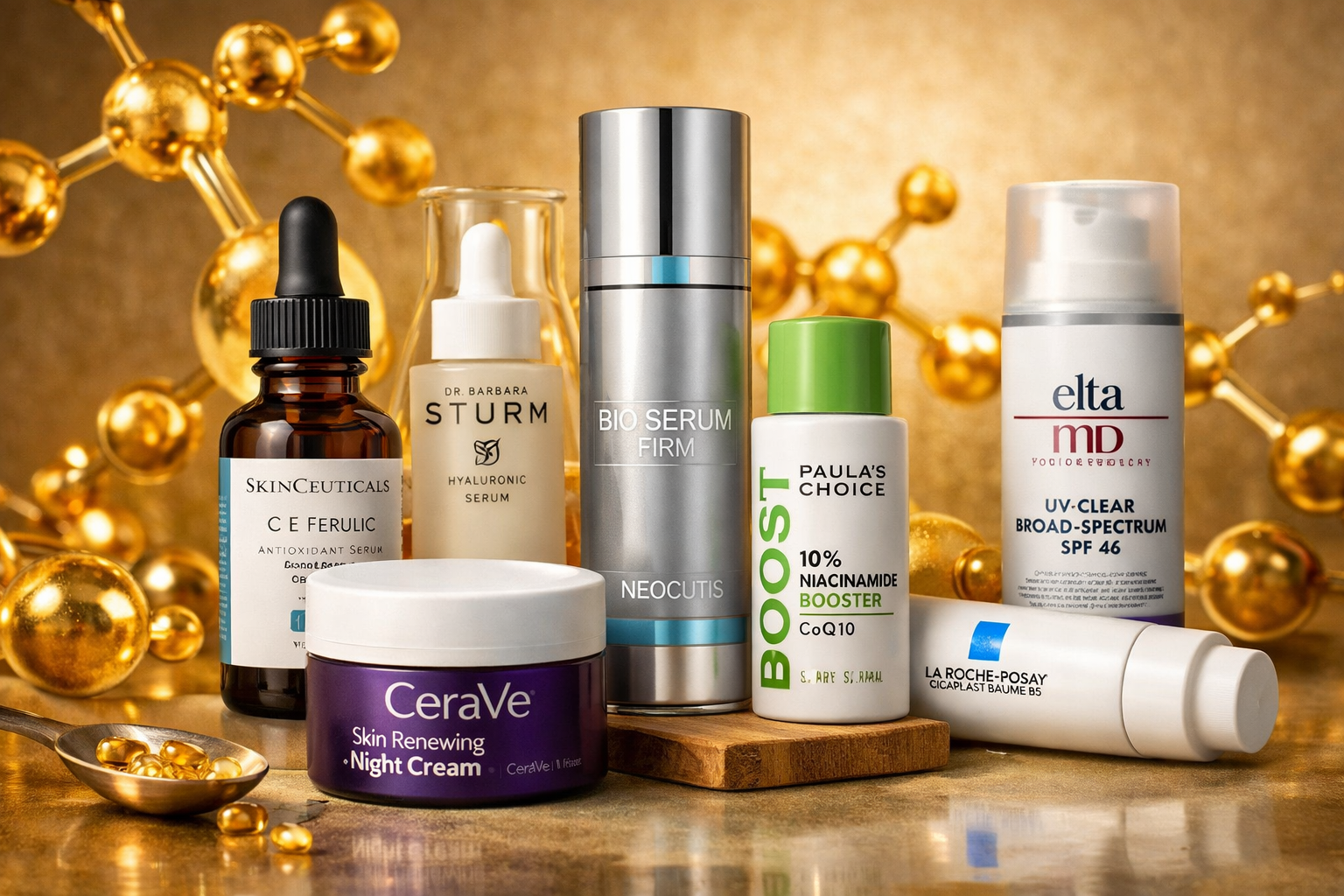
CoQ10 Skincare Reference Chart
| Product | Tier | CoQ10 Role | Best For | The Luxe Source |
|---|---|---|---|---|
| SkinCeuticals C E Ferulic | Luxe | Complementary antioxidant synergy | Vitamin C + E amplify CoQ10 defense | Explore |
| Dr. Barbara Sturm Hyaluron Serum | Luxe | Purslane antioxidant complement | Deep hydration + antioxidant layering | Explore |
| Neocutis Bio Serum Firm | Luxe | Growth factor + antioxidant approach | Collagen rebuilding alongside CoQ10 | Explore |
| Paula’s Choice 10% Niacinamide Booster | Elevated | Niacinamide pairs with CoQ10 | Barrier repair + pore refinement | Explore |
| EltaMD UV Clear SPF 46 | Elevated | Antioxidant SPF protection | UV defense preserves CoQ10 levels | Explore |
| CeraVe Skin Renewing Night Cream | Essentials | Contains CoQ10 directly | Accessible CoQ10 entry + barrier repair | Explore |
| La Roche-Posay Cicaplast Baume B5 | Essentials | Barrier repair aids CoQ10 absorption | Compromised barrier + sensitivity | Explore |
What Is CoQ10 and Why Does It Matter After 40?
Coenzyme Q10 — also known as ubiquinone — is a lipid-soluble molecule that lives inside the mitochondria of every cell. It serves two critical functions. First, CoQ10 is essential for ATP production, the energy currency that powers all cellular processes including collagen synthesis, elastin maintenance, and wound repair. Second, this molecule works is a potent antioxidant that neutralizes free radicals before they can damage DNA, lipids, and proteins in the skin.
A peer-reviewed study published in the Journal of Clinical and Aesthetic Dermatology confirmed that topical CoQ10 application replenishes cellular levels, normalizes energy homeostasis, and provides antioxidative effects that support and repair cutaneous damage. For women over 40, this is significant: declining CoQ10 levels directly correlate with the visible signs of aging — thinner skin, slower healing, deeper wrinkles, and diminished radiance.
Board-certified dermatologist Dr. Madeleine Gantz of Westlake Dermatology notes that CoQ10 is particularly beneficial for mature skin, helping restore lost elasticity and reducing fine lines and wrinkles while protecting against oxidative stress from pollution and UV radiation.
The Science: How CoQ10 Fights Aging at the Cellular Level
Energy Production and Cellular Repair
CoQ10’s primary role is powering the mitochondrial electron transport chain — the process that converts nutrients into ATP. When topical formulations deliver this molecule topically, it reaches both the stratum corneum and deeper epidermal layers, boosting energy metabolism in cells that have been running on depleted reserves. More cellular energy means faster turnover, more efficient collagen production, and stronger barrier function.
Antioxidant Defense
Free radicals from UV exposure, pollution, and ozone damage collagen by activating matrix metalloproteinases (MMPs) — enzymes that break down the structural proteins holding skin together. Research demonstrates that CoQ10 inhibits MMP expression and subsequent collagen degradation, providing a direct defense mechanism against the enzymatic processes that cause visible sagging and wrinkling.
Collagen and Elastin Protection
A landmark study by Hoppe et al. showed that topical CoQ10 reduced wrinkle depth around the eyes after six months of application, while simultaneously reducing collagenase expression in dermal fibroblasts exposed to UV radiation. For women over 40 whose collagen is already declining at approximately 1% per year, this protective effect compounds meaningfully over time.
What Makes CoQ10 Unique Among Antioxidants
Most antioxidants in skincare — vitamin C, vitamin E, niacinamide, resveratrol — work primarily as free radical scavengers. CoQ10 does that too, but it also serves a function no other topical antioxidant replicates: powering the mitochondrial electron transport chain that generates ATP. This dual role means CoQ10 skincare doesn’t just defend against damage — it gives cells the energy to repair damage that has already occurred. For mature skin operating on depleted cellular reserves, that distinction matters. A cell with adequate energy and antioxidant protection ages more slowly than a cell with only one or the other. This is why dermatologists increasingly recommend CoQ10 as part of a multi-antioxidant strategy rather than a standalone treatment — it fills a role the other antioxidants structurally cannot.
CoQ10 Skincare and Antioxidant Synergy: The Layering Strategy
CoQ10 is most effective when layered with complementary antioxidants. This is where understanding the relationship between this ingredient and your existing routine becomes essential.
CoQ10 + Vitamin C + Vitamin E: This trio creates a synergistic antioxidant network. Vitamin C neutralizes water-soluble free radicals while CoQ10 and vitamin E handle lipid-soluble ones. SkinCeuticals C E Ferulic delivers the vitamin C and E components at clinical concentrations, making it an ideal complement to any CoQ10 product in your routine.
CoQ10 + Niacinamide: Niacinamide supports NAD+ production — another critical energy molecule for skin cells — while CoQ10 powers mitochondrial function. Together, they address cellular energy from two different pathways. Paula’s Choice 10% Niacinamide Booster is a strong pairing option.
CoQ10 + Growth Factors: While CoQ10 energizes cells and protects collagen, growth factors like those in Neocutis Bio Serum Firm signal cells to produce new collagen, elastin, and hyaluronic acid. The combination addresses both defense and active rebuilding — the two pillars of any serious anti-aging strategy after 40.
CoQ10 + SPF: UV radiation is the single largest contributor to CoQ10 depletion in the skin. Using an antioxidant SPF like EltaMD UV Clear alongside topical CoQ10 prevents further depletion while the topical CoQ10 replenishes existing deficits. This pairing is non-negotiable for women over 40.
How to Incorporate CoQ10 Skincare Into Your Routine
CoQ10 is lipid-soluble, which means it absorbs best when formulated in oil-based or emulsion vehicles. Look for CoQ10 skincare products with concentrations of 1% or higher — the threshold supported by clinical evidence. Apply in the evening when the skin’s natural repair processes are most active, though morning application provides antioxidant defense throughout the day. CoQ10 pairs well with virtually all active ingredients including retinol, peptides, hyaluronic acid, and niacinamide. No conflicts, no required waiting periods — just layer it into your existing sequence after serums and before your moisturizer.
For women over 40 building a comprehensive antioxidant strategy, CoQ10 fills the cellular energy gap that vitamin C, vitamin E, and niacinamide cannot address alone. It’s the missing piece in the antioxidant puzzle — the ingredient that powers the machinery the other antioxidants are protecting.
Frequently Asked Questions About CoQ10 Skincare
What is CoQ10 and why should women over 40 care about it?
CoQ10 is a naturally occurring antioxidant that powers cellular energy production in the mitochondria. After 40, your skin’s CoQ10 levels have declined significantly, reducing cellular repair capacity and collagen synthesis. Topical CoQ10 replenishes what aging depletes.
How is CoQ10 different from vitamin C as an antioxidant?
Vitamin C is water-soluble and works primarily in the aqueous (water-based) environment of the skin. CoQ10 is lipid-soluble and works within cell membranes and mitochondria. They complement each other — vitamin C protects the surface, CoQ10 protects the cellular interior.
Can I use CoQ10 skincare with retinol?
Yes. CoQ10 and retinol work through entirely different mechanisms and are fully compatible. CoQ10 may actually help mitigate some of the oxidative stress associated with retinol use.
What concentration of CoQ10 should I look for?
Clinical evidence supports concentrations of 1% or higher for visible anti-aging benefits. Lower concentrations still provide antioxidant protection but may take longer to show measurable results.
Is CoQ10 skincare suitable for sensitive skin?
Yes. Research confirms that CoQ10 shows no cytotoxicity even at high concentrations and its irritancy potential is minimal. It is well-tolerated by sensitive, rosacea-prone, and reactive skin types.
When in my routine should I apply CoQ10?
Apply CoQ10 skincare after water-based serums and before your moisturizer. Because CoQ10 is lipid-soluble, it absorbs well in oil-based or emulsion formats. It works effectively both morning and evening.
Does CoQ10 skincare help with dark spots or hyperpigmentation?
CoQ10 primarily addresses oxidative damage and cellular energy rather than melanin production. For dark spots, pair it with targeted brightening ingredients like vitamin C or niacinamide.
How long before I see results from CoQ10 skincare?
Hydration and radiance improvements may be visible within two weeks. Wrinkle depth reduction typically requires six to eight weeks of consistent application, as demonstrated in clinical studies.
Can I get enough CoQ10 from diet alone?
Dietary CoQ10 supports systemic antioxidant levels, but topical application delivers CoQ10 directly to the skin layers where aging occurs. Both approaches complement each other — supplements for systemic benefit, topical for targeted skin results.
Is ubiquinone the same as CoQ10?
Yes. Ubiquinone is the chemical name for CoQ10. On ingredient labels, you may see it listed as ubiquinone, coenzyme Q10, or CoQ10. All refer to the same molecule.
Does CoQ10 replace my sunscreen?
No. CoQ10 provides antioxidant protection against free radical damage but does not block UV rays. Always use a broad-spectrum SPF of 30 or higher as the final step in your morning routine. CoQ10 complements sunscreen — it does not replace it.
Can I use CoQ10 skincare around my eyes?
Yes. CoQ10 is gentle and well-tolerated in the periorbital area. Research specifically demonstrated wrinkle depth reduction around the eye area after six months of topical CoQ10 application.
What is the difference between ubiquinone and idebenone?
Both are related to CoQ10, but they function differently. Ubiquinone is natural CoQ10 — the form your body produces and recognizes. Idebenone is a synthetic derivative that was once popular in skincare but has fallen out of favor due to its potential to cause skin allergies. Board-certified dermatologist Dr. Leslie Baumann recommends products containing natural ubiquinone over idebenone for safer and more effective results.
Previously in The Vault: Best Dr. Barbara Sturm Products for Women Over 40
Coming next: Best Lip Treatments & Serums for Women Over 40 — The Vault curates the definitive lip care roundup for mature skin, from peptide-powered plumping serums to barrier-repair balms that address the thinning, feathering, and dryness that accelerate after 40.
Comments are closed