This article contains affiliate links. If you purchase through these links, we may earn a commission at no extra cost to you.
If you’ve spent any time researching anti-aging skincare, you’ve landed squarely in the middle of the retinol vs retinoids debate — and for good reason. Both promise to dramatically improve skin texture, tone, and collagen production. Both are derived from vitamin A. And both are backed by decades of powerful clinical research. But they are not the same thing — and once you’re past 40, understanding the distinction can genuinely transform your results.
The retinol vs retinoids conversation matters more at this stage of life because mature skin operates differently. Collagen production has slowed. Cell turnover has decelerated. The barrier is more susceptible to irritation. Using the wrong form, at the wrong strength, at the wrong pace is one of the most common reasons women over 40 abandon vitamin A entirely — and that is a mistake The Vault is determined to help you avoid.
This retinol vs retinoids guide breaks down exactly what each form is, how they powerfully differ, and how to confidently incorporate them into a complete anti-aging skincare routine without unnecessary irritation or guesswork.
Table of Contents
What Are Retinoids? The Vitamin A Family Explained
Understanding the retinol vs retinoids question starts with the big picture. “Retinoids” is the umbrella term for the entire family of vitamin A derivatives used in skincare. Retinol is one celebrated member of that family — but it’s far from the only one.
Every retinoid works toward the same ultimate goal: converting into retinoic acid inside the skin. Retinoic acid is the biologically active form that your skin cells actually respond to. The difference between every retinoid product on the market comes down to how many steps that conversion requires, and how potent the result is. According to the American Academy of Dermatology, retinoids have been proven to boost collagen production, improve skin tone, and visibly reduce fine lines and wrinkles — making them one of the most well-researched categories in all of skincare.
Here is how the full retinoid spectrum breaks down, from gentlest to strongest:
- Retinyl Palmitate — The mildest form. Requires multiple conversion steps before becoming active retinoic acid. Best suited to true beginners or those with highly reactive skin.
- Retinol — The most widely available over-the-counter form. Moderately potent, converts in two steps. The gold standard for OTC anti-aging.
- Retinaldehyde (Retinal) — One conversion step away from retinoic acid, making it significantly stronger than retinol but still available without a prescription. A compelling and effective middle ground.
- Adapalene — A synthetic retinoid available OTC at 0.1% strength. Originally developed for acne but increasingly studied for its impressive anti-aging benefits.
- Tretinoin (Retinoic Acid) — Prescription-only. No conversion needed. Directly activates skin cell receptors. The most potent, most studied, and most transformative form available.
Retinol vs. Retinoids — What’s the Real Difference?
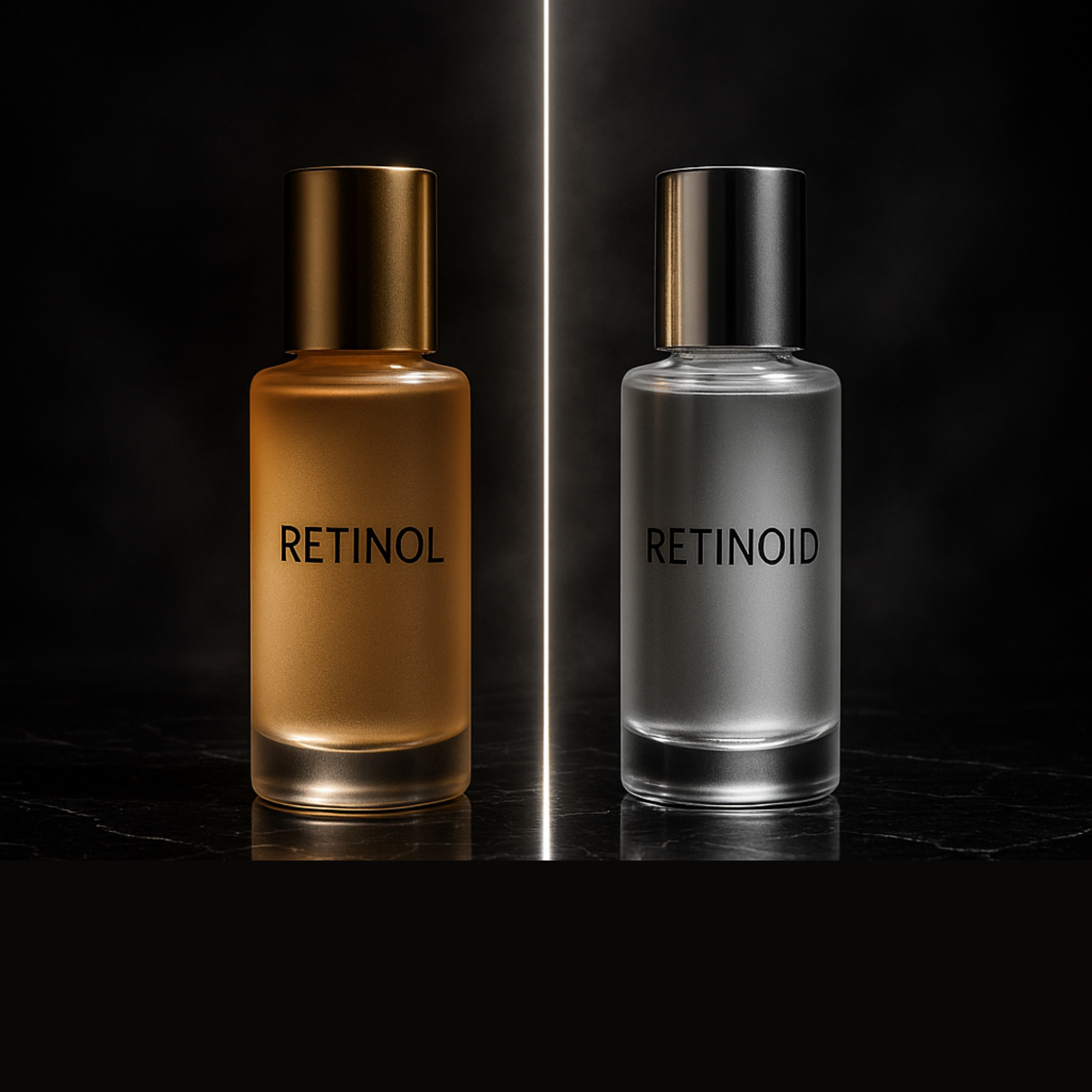
This is the question The Vault hears most often — and getting the retinol vs retinoids distinction right is genuinely empowering. The simplest answer: retinol is a retinoid, but not all retinoids are retinol.
When someone says “retinoid,” they typically mean a prescription-strength product — usually tretinoin, tazarotene, or adapalene prescribed by a dermatologist. When someone says “retinol,” they mean the over-the-counter vitamin A derivative found in everything from accessible serums to exceptional luxury formulas.
The clinical distinction is meaningful and worth understanding clearly. As Dr. Zakia Rahman, MD, a Stanford University dermatologist, explains: prescription retinoids are classified as a pharmaceutical, meaning they work at a deeper, faster level — but with that potency comes a higher likelihood of the adjustment period commonly known as “retinoid uglies.” The good news is that this phase is entirely temporary.
Retinol, by contrast, has a gentler effect and results build over time — but the results are real and proven. Dr. Rahman puts it positively: “Often, retinols are a good place to start for people who are just looking to try it out.” That is an excellent entry point into the retinol vs retinoids journey.
The key practical differences at a glance:
| Retinol (OTC) | Prescription Retinoid | |
|---|---|---|
| Strength | Moderate | High |
| Results timeline | 8–12 weeks | 4–8 weeks |
| Irritation risk | Lower | Higher |
| Prescription required | No | Yes |
| Best for | Beginners, maintenance, sensitive skin | Deep wrinkles, stubborn pigmentation, experienced users |
If you’re already using retinol for mature skin and wondering whether to graduate to a prescription, our guide to the best retinol serums for mature skin over 40 walks through the top-performing formulas at every strength level.
The Retinoid Spectrum: A Powerful Toolkit for Mature Skin
Understanding the full retinoid spectrum is genuinely exciting for women over 40 because it means there is always a right answer for your skin — regardless of where you’re starting. Dr. Fricke of Alamo Heights Dermatology summarizes the spectrum clearly: the key difference between all retinoid forms lies in their strength and how many steps they take to convert into retinoic acid.
In the context of retinol vs retinoids for mature skin specifically, the spectrum matters because hormonal changes — particularly during perimenopause and menopause — often push skin toward greater dryness and reactivity. A form that would be perfectly tolerated at 32 may need a gentler approach at 52. The great news: there are outstanding options at every level.
Here’s how to think about the spectrum in practical terms:
Retinyl Palmitate is rarely the best investment as an anti-aging active. The conversion chain is too long, and the concentration needed for visible results is rarely achievable in stable OTC formulas. Step up when you’re ready.
Retinol (0.025%–0.1%) is where most women over 40 can confidently begin. Consultant dermatologist Dr. Justine Kluk recommends starting at 0.3% — widely available and well-tolerated by most skin types — and building strength over time. “It’s always a good idea to start at a low strength and build up the strength gradually,” she advises. “Stronger retinoids can make skin dry and irritable at first, so starting low will make the process seamless.”
Retinaldehyde is an excellent upgrade for women who have used retinol consistently for at least a year and want stronger results without a prescription. It delivers faster results than standard retinol with less irritation than tretinoin — a rewarding next step in the retinol vs retinoids progression.
Tretinoin (0.025%–0.1%) remains the gold standard for clinical outcomes. For women with significant photodamage, deep lines, or stubborn hyperpigmentation that hasn’t responded to OTC retinol, the prescription route delivers remarkable results. A landmark study published in the NIH’s National Library of Medicine confirmed that retinoids produce measurable improvements in fine wrinkles, skin tone, and collagen density — with benefits that compound positively over time.
Why Retinol vs. Retinoids Matters More After 40
The retinol vs retinoids question becomes especially meaningful once estrogen levels begin to decline. The reduction in collagen production during perimenopause and menopause is the primary reason skin changes so visibly in your forties and fifties. As Dr. Justine Kluk explains: “Collagen is a protein that keeps our skin firm, and the sharp decrease of collagen in our skin during perimenopause and into menopause is the reason why it changes so much in our forties and fifties. Using retinoids can help to slow this process down and also help us generate new collagen.”
The empowering news: it is never too late to start. Dr. Kluk is clear and encouraging on this point: “There’s a sweet spot, from your late 20s until your early 50s, but when you’re in your 40s or 50s, it can absolutely still give your skin incredible results. You just have to use it correctly and pick the right strength.”
Whether you’re navigating the retinol vs retinoids question for the first time or reassessing an existing routine, mature skin responds beautifully to vitamin A when it is introduced properly. Pairing vitamin A with a well-formulated moisturizer becomes non-negotiable at this stage. The Vault’s guide to the best moisturizers for mature skin over 40 includes several barrier-support formulas specifically suited to buffering retinoid use.
How to Start Retinol After 40 — A Proven Protocol
The single biggest mistake women over 40 make in the retinol vs retinoids journey is going in too strong, too fast. Dr. Tina Alster, MD, FAAD, clinical professor of dermatology at Georgetown University Medical Center, has a clear and effective recommendation: “Many patients want to start right off with tretinoin, but I advise them to use the least-intense retinoid formula they can find, and use it every other night to start, slowly building up.”
The protocol The Vault recommends for mature skin beginners:
Weeks 1–2: Apply a low-strength retinol (0.025%–0.05%) once per week, over moisturizer. This “sandwich method” — moisturizer, then retinol, then moisturizer — reduces barrier disruption significantly while still delivering results.
Weeks 3–4: If skin is tolerating well with no persistent redness or flaking, move to twice per week application. This is a positive milestone in the retinol vs retinoids learning curve.
Month 2–3: Gradually increase to three to four nights per week. Most women reach comfortable nightly use by month three.
Month 4+: If results have plateaued after six months of consistent use, consult a dermatologist about stepping up to retinaldehyde or a low-strength prescription tretinoin. Stanford’s Dr. Rahman confirms: “Personally, I’m a huge fan of retinoids and likely the majority of dermatologists who you speak to are on some type of topical retinoid regimen” — a powerful endorsement for staying the course.
As Toronto dermatologist Dr. Benjamin Barankin notes: “In your 40s onwards, we’re starting to get drier, and so applying a moisturizer first before the retinol will make more sense. If you get too dry or red or peeling or irritated from retinol, simply take a break for two to three nights, moisturize only, and then resume using it. Our skin will typically get used to the products over time.”
What pairs beautifully with retinol:
- Vitamin C (morning): Retinol works at night; vitamin C works in the morning. They amplify each other’s collagen support without competing. The Vault’s best vitamin C serums for mature skin are formulated specifically for the sensitivity needs of skin over 40.
- Peptides: An excellent supporting cast alongside retinol for firmness and repair. Explore the peptides for skin firming guide for compatible pairings.
- Niacinamide: One of the best companions for retinol. Strengthens the barrier, reduces redness, and significantly improves tolerance. As Dr. Fricke confirms: “Niacinamide: Great pairing. Helps calm irritation and strengthen the skin barrier.”
- Hyaluronic acid: Essential for hydration support during retinol adjustment. See the best hyaluronic acid serums for mature skin for top recommendations.
Pairing Retinol With the Rest of Your Routine — Retinol vs Retinoids in Practice
Retinol doesn’t exist in isolation — and understanding how it interacts with your routine is key to unlocking its full potential. Its relationship with sunscreen, exfoliants, and hydration determines how well it performs and how comfortably your skin tolerates it.
Sunscreen is non-negotiable and highly protective. Retinoids of every form increase photosensitivity. Dr. Rahman’s advice is direct: “All you have to do is make sure you’re wearing sunscreen every day, which we should all be doing anyway.” The Vault’s best sunscreens for mature skin over 40 includes excellent daily SPF options formulated for compatibility with active ingredients.
Avoid layering with AHAs/BHAs on the same night. Both are exfoliating actives, and combining them with retinol — particularly in the early weeks — increases irritation risk unnecessarily. Dr. Fricke’s sound guidance: “AHAs/BHAs can increase irritation. Avoid using them on the same night as your retinoid unless your skin is very tolerant.”
Night cream support is a worthy investment. During the adjustment phase, a rich, barrier-focused night cream for mature skin layered over retinol helps lock in hydration and supports the skin beautifully through its transformation.
Don’t neglect the eye area. Retinol should be kept away from the direct eye contour, but the surrounding skin benefits from a dedicated eye treatment. The best eye creams for fine lines and dark circles covers the outstanding options for that delicate zone.
Frequently Asked Questions: Retinol vs. Retinoids for Women Over 40
Q: Is it too late to start retinol vs retinoids after 40? Absolutely not — and this is one of the most encouraging things to understand. Dermatologists consistently confirm that vitamin A delivers real, meaningful anti-aging results at any age. Starting later simply means building realistic expectations around timeline, but the collagen stimulation and cell turnover benefits are fully achievable and well worth pursuing.
Q: Should I go straight to prescription tretinoin if I’m 50+? Not necessarily. Your skin type, current sensitivity level, and barrier health matter more than age alone. Many women over 50 achieve beautiful results with high-strength OTC retinol or retinaldehyde. A dermatologist consultation will give you the most accurate and personalized guidance for your retinol vs retinoids decision.
Q: How long does it take to see results from retinol? With prescription tretinoin, visible improvement can appear within four weeks. OTC retinol typically requires eight to twelve weeks of consistent use before changes — smoother texture, more even tone — become apparent. Full collagen remodeling benefits compound beautifully over six months or longer.
Q: Can I use retinol every night? Eventually, yes — and nightly use is an excellent goal. Most dermatologists recommend building up gradually over three to four months. Starting with every-other-night application allows your skin to acclimate comfortably and successfully.
Q: What strength retinol should I start with after 40? Most dermatologists recommend beginning with 0.025%–0.05% for dry or sensitive skin, or 0.05%–0.1% for more resilient skin types. Dr. Kluk considers 0.3% a well-tolerated and effective starting point for most users navigating the retinol vs retinoids spectrum.
Q: Can I use retinol if I have sensitive skin or rosacea? Cautiously and successfully, yes. Start at the lowest possible strength, use the sandwich method, and limit frequency to once or twice per week. Dr. Anne Chapas, MD, FAAD, advises that those with significant redness or inflammation should consult their dermatologist before starting any retinoid — but the right formula can still be a positive and effective addition to the routine.
Q: What is the “retinoid uglies” phase? This refers to the temporary adjustment period — typically two to four weeks — during which skin may experience increased dryness or sensitivity before acclimating. It is entirely manageable with proper moisturization and a gradual protocol, and it signals that the ingredient is actively working.
Q: Is retinaldehyde better than retinol for women over 40? For women who have built retinol tolerance and want stronger results without a prescription, retinaldehyde is an excellent and rewarding upgrade — a compelling step in the retinol vs retinoids progression that delivers superior results to standard retinol with better tolerability than tretinoin.
Q: Can I use retinol while going through perimenopause? Yes, and it is one of the most beneficial investments you can make for perimenopausal skin. Start with the lowest possible strength, prioritize barrier support, and build gradually. The collagen-stimulating benefits are especially valuable during this hormonal transition.
Q: Does retinol help with menopausal skin changes specifically? Yes — meaningfully so. The collagen loss that accelerates during menopause is one of the conditions vitamin A addresses most effectively. Consistent retinol use supports collagen synthesis and cell turnover, helping to counteract the key drivers of menopausal skin aging.
Q: Should I apply retinol before or after moisturizer? For sensitive or dry mature skin, apply moisturizer first (the sandwich method), then retinol, then a second layer of moisturizer. This approach is highly effective at reducing irritation while still delivering excellent results. As your skin builds tolerance, you can transition to applying retinol directly on clean skin.
Q: Can retinol cause purging? Yes, particularly in acne-prone skin. Purging — a temporary increase in breakouts — occurs as accelerated cell turnover brings congestion to the surface. It typically resolves within four to six weeks and is a sign the ingredient is actively working.
Q: Does retinol interact with vitamin C? They are exceptional complements when used at different times of day. Vitamin C in the morning for antioxidant protection and brightening; retinol at night for repair and renewal. Together, they form one of the most proven and effective anti-aging duos in skincare.
Q: How do I know if I’m ready to upgrade to prescription tretinoin? If you’ve used OTC retinol consistently for six or more months and results have plateaued, a dermatologist consultation about prescription retinoids is an excellent and well-timed next step in your retinol vs retinoids journey.
Q: Does retinol make skin thinner? Counterintuitively, no — it makes skin structurally stronger over time. While retinoids thin the stratum corneum (the outermost dead-cell layer), they simultaneously thicken the living epidermis and stimulate collagen in the dermis. That is one of the most remarkable and exciting things about consistent retinol vs retinoids use for mature skin.
References:
- American Academy of Dermatology — Retinoid or Retinol?
- National Institutes of Health, National Library of Medicine — Retinoids in the Treatment of Skin Aging: An Overview of Clinical Efficacy and Safety
- Stanford Medicine — Does Retinol Deserve the Hype? A Stanford Dermatologist Weighs In
📌 Previously in The Vault: Best Anti-Aging Serums for Mature Skin Over 40
📌 Coming Next: Estée Lauder Advanced Night Repair Serum — The VVL Review
Comments are closed